
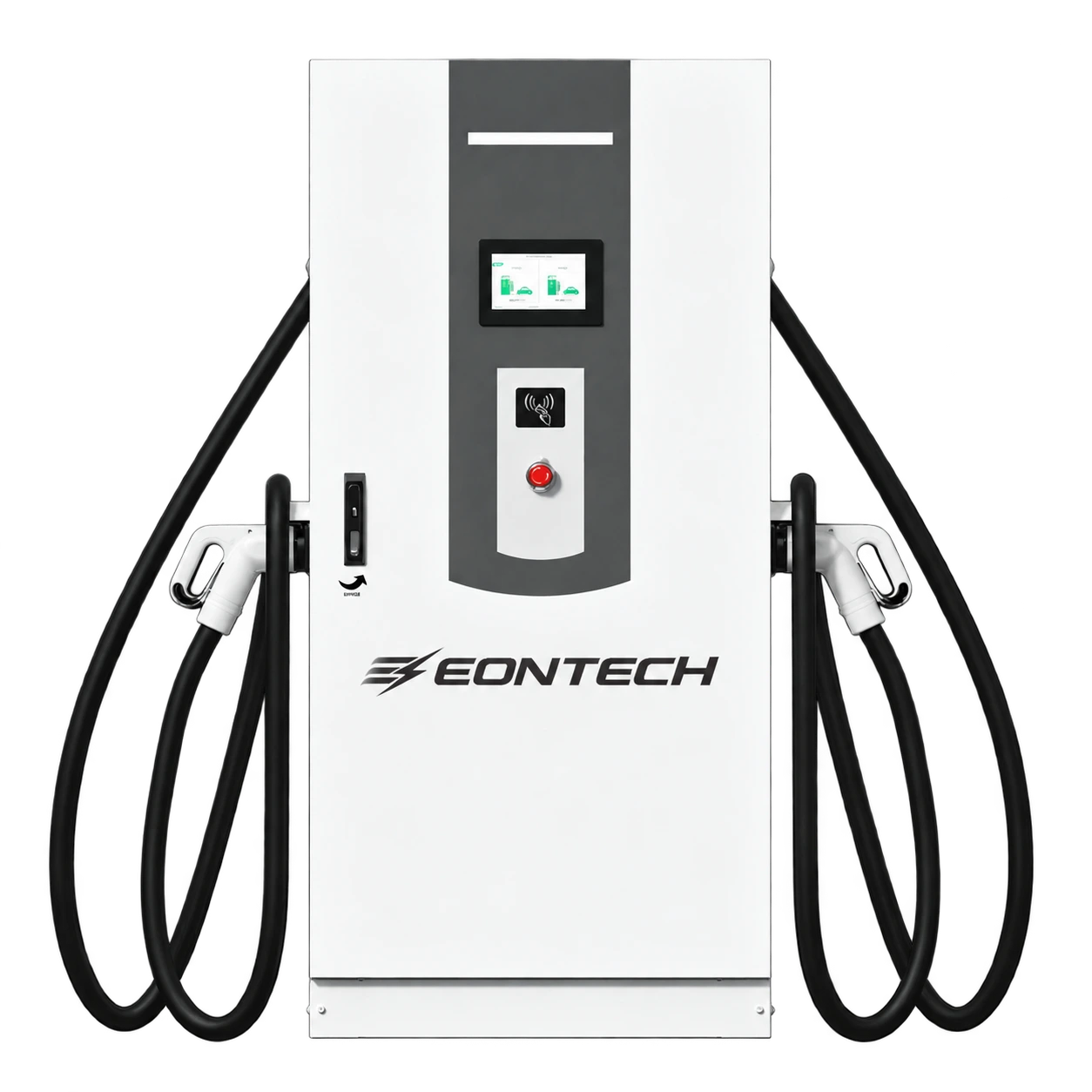
This guide uses the EONTECH EON120KW-400KW family as a supplier-documented example, with its specifications and unresolved configuration questions set out below. [E1]
For a fleet depot or public charging site, the useful procurement question is simple: what can this exact configuration deliver to the vehicles you plan to charge at the same time?
1. Separate the cabinet rating from the output at each connector
Ask the supplier to identify three values in its proposal: total available DC output, maximum output through either connector when used alone, and the supported combinations when both connectors are active. A family rating such as 120–400 kW describes a range of orderable models; it is not a promise that every unit can deliver every rating.
Two connectors also do not prove two full-power outputs. A dual-connector charger may use shared power, a fixed allocation or another arrangement. The exact hardware and control configuration must establish what is available. Do not calculate two-vehicle performance by multiplying the cabinet rating by two.
Request a model-specific table rather than a statement such as “intelligent power sharing.” It should cover these operating conditions:
These are procurement questions, not a statement that every charger supports each behavior.
| Parameter | Specification |
|---|---|
| One vehicle on connector A | Available output and voltage/current conditions |
| One vehicle on connector B | Whether the same output is available on either connector |
| Two vehicles requesting high power | Combined limit and each connector’s allocation |
| One vehicle reduces its demand | Whether unused capacity can move to the other connector |
| A second vehicle connects or a session ends | Reallocation behavior and any session interruption |
| A site power limit is active | How the cabinet and connector limits respond |
2. Check voltage and current before comparing kW
For DC output, power in kilowatts equals voltage multiplied by current, divided by 1,000. This helps explain why a current limit can matter even when a charger has a high advertised power rating.
Illustrative arithmetic only, not EONTECH test results or guaranteed operating points: 400 V at 350 A equals 140 kW, while 800 V at the same current equals 280 kW. Actual output remains limited by the selected charger, its power envelope, connector and cable limits, allocation settings and the vehicle’s charging request.
A battery voltage also changes during charging. Ask for the operating envelope relevant to your vehicles, including any constant-power range and continuous-current restrictions. Do not treat the highest voltage, current and power figures on a family datasheet as values that are simultaneously available on every model and connector.
Calculated examples only. Actual charger output depends on the selected equipment and operating conditions.
3. Distinguish power sharing inside a charger from site load management
Power sharing describes how available charging power is divided between outputs. Site load management addresses the wider site supply and other loads. A charger may need to respond to a site limit as well as individual vehicle requests.
Ask where each decision is made: in the charger, a local controller or the charging management system. Then ask which settings and functions are actually implemented for the proposed equipment and backend.
The Open Charge Alliance describes OCPP as the communication protocol between charging stations and charging management systems. A listed OCPP version is useful integration information, but it does not specify a particular cabinet’s power-allocation architecture. It also does not, on its own, demonstrate certification or successful integration with your chosen backend. [E2]
Include the backend version, firmware and agreed control functions in the integration review. Ask how the equipment behaves if communication is lost; treat the answer as a requirement to verify, rather than assuming an offline strategy is included.
4. Apply temperature and continuous-output conditions
A maximum or boost current needs its applicable conditions. Ask whether a quoted current is continuous, optional or time-limited, and what ambient temperature, cable and cooling configuration it assumes. Do not use a boost figure as the basis of a depot timetable until those conditions are documented.
Temperature derating matters for power-sharing comparisons too. A proposal should identify the output available under the site’s expected operating conditions, including simultaneous charging. An operating temperature range does not mean full rated output throughout that range.
Keep efficiency separate from delivered charging power. Peak conversion efficiency is a particular performance figure, not a guaranteed efficiency at every load or proof that vehicles receive the cabinet rating.
5. What EONTECH documents—and what to confirm for your order
EONTECH, identified on its website as EON New Energy Technology (Suzhou) Co., Ltd., lists the following for its EON120KW-400KW CCS2 DC charger family. These are the supplier’s documented family specifications; the order should identify the exact selected model. [E1]
EONTECH’s product page states that two CCS2 connectors are provided and tells buyers to confirm simultaneous charging behaviour and power sharing in the model-specific proposal. It does not provide an allocation table. The exact split, access to full cabinet power through one connector, allocation increments, transition times and offline control behavior still need configuration-specific confirmation. [E1]
| Parameter | Specification |
|---|---|
| Rated options: 120, 160, 200, 240, 320, 360 and 400 kW | Select an orderable rating; do not treat 400 kW as the output of every model |
| Two CCS2 connectors; 200–1000 V output range | Check the vehicle mix and the conditions for simultaneous operation |
| Maximum current listed as 350 A at CCS2; a 500 A boost option requires confirmation | Confirm per-connector, continuous and boost conditions for the configuration |
| 96% peak efficiency | Use the figure as a peak value, not an all-load guarantee |
| Operation from −25°C to 65°C; derating above 50°C | Request the relevant output conditions for hot-weather operation |
| OCPP 1.6J / 2.0.1 listed | Confirm the implemented functions and target backend integration |
6. Send a request that produces a comparable answer
Provide your intended vehicles, their charging interfaces and voltage requirements, expected arrival and departure times, available site supply, target backend and operating temperatures. Ask the supplier to return a proposal naming the charger model, hardware options and firmware, with the one- and two-connector output table above.
For the demonstration or acceptance test, agree the vehicle conditions and the records to capture: both sessions starting, one vehicle reducing demand, and one session ending. Compare the recorded outputs and transitions with the contracted configuration. This is a recommended verification approach, not a claim that a particular test has already been completed.
A useful quotation makes the limits visible. It lets you compare the output your site needs with what the selected equipment can deliver under agreed conditions.
Frequently asked questions
Does a 240 kW dual-connector charger deliver 240 kW to each vehicle?
Do not assume so. First establish what the 240 kW rating refers to. If it is the combined cabinet limit, two vehicles cannot each receive 240 kW from that cabinet at the same time. Ask for the supported per-connector allocations and their conditions. EONTECH’s product page lists rated power by model and does not state a per-connector allocation.
Is dynamic power sharing always a 50/50 split?
The phrase does not establish a fixed split. Request the supported allocation rules, including whether unequal allocations are available and how the system responds when vehicle demand changes. EONTECH’s exact allocation options require configuration-specific confirmation.
Does OCPP 2.0.1 support guarantee a particular power-sharing behavior?
No. OCPP concerns communication with the charging management system. The charger’s hardware, implemented functions, configuration and backend integration must establish the actual behavior. Confirm those details separately. [E2]
What should I send EONTECH before requesting a configuration?
Send the required power option, vehicle mix, connector requirements, charging windows, available supply, backend and operating conditions. Request written confirmation of simultaneous charging behavior and the allocation table for the proposed model.
Discuss your CCS2 configuration
Review the EONTECH CCS2 DC charger family (EONTECH) and send your project requirements (EONTECH). Include the conditions above so the team can respond with a configuration and its stated output limits.
Related reading: DC charging site planning (EONTECH), OCPP, payments and operations (EONTECH), and depot charging handover records (EONTECH).
Source notes
[E1] EONTECH, CCS2 DC fast chargers, 120–400 kW: https://www.eonsz.com/products/ccs2-dc-chargers/ . Supplier product information, checked 17 November 2026. The page states that its specifications are extracted from the company profile (page 8); both are supplier materials, not an independent product test.
[E2] Open Charge Alliance, Open Charge Point Protocol: https://openchargealliance.org/protocols/open-charge-point-protocol/ . Used for the scope of OCPP, not as evidence of EONTECH certification or model-specific functionality.