
Quick answer
Bus fleet depot charging configurations combine intelligent charging scheduling, adaptive power distribution and optional auxiliary BESS, as shown in São Paulo and Mexico urban depot references, to fit limited station space and support stable operation for public transport fleets.
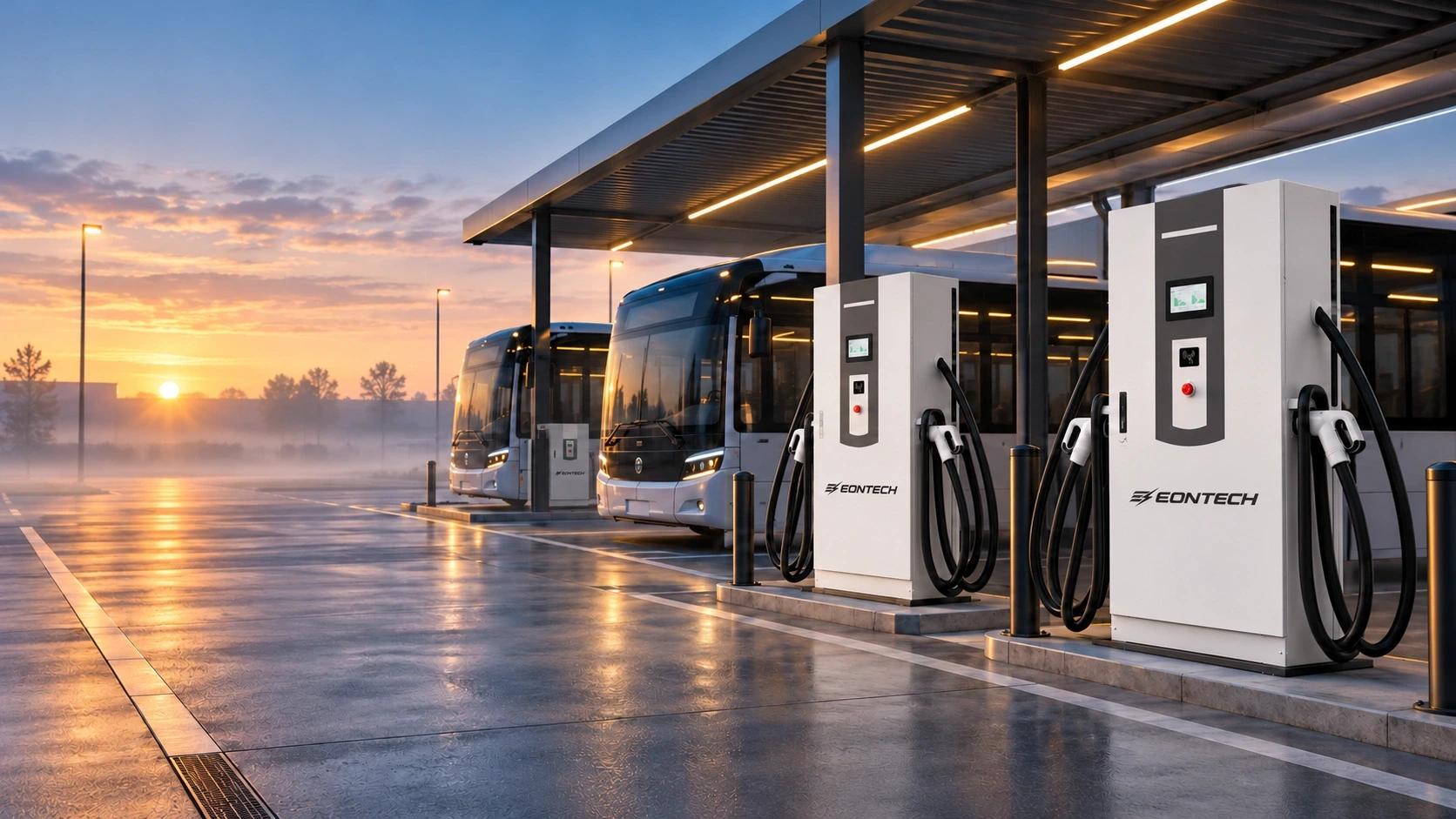
Bus and fleet depots
Review bus and fleet depot charging configurations
Connect depot layout, vehicle schedules and energy supply in one charging plan. Explore our Brazil and Mexico configurations for scheduling, storage, space and power allocation.
Discuss your requirements ↗Charging infrastructure discussion
We provide charging infrastructure solutions for fleet projects. Connect equipment selection with the fleet operating schedule and site constraints when preparing your depot enquiry.
Brazil depot reference
Our Brazil bus-depot configuration brings intelligent charging scheduling together with auxiliary BESS. Discuss vehicle return times, the charging window and the intended storage role for your own depot.
Mexico compact depot reference
Our Mexico configuration combines compact depot charging, remote operations and maintenance and adaptive power distribution for constrained station space. Use your parking plan, vehicle schedule and available supply to define a site-specific equipment list.
Prepare the duty-cycle and layout brief
List the vehicles, charging interfaces, arrival and departure windows, parking positions and available supply. Ask how scheduling, output allocation and any storage proposal would be confirmed. Request the current equipment documents, control interfaces and division of responsibilities.
Frequently asked questions
What does a bus fleet depot charging configuration include?
A bus fleet depot charging configuration can combine intelligent charging scheduling, adaptive power distribution and an auxiliary battery energy storage system. The São Paulo urban electric bus depot reference is equipped with intelligent charging scheduling and an auxiliary BESS, while the Mexico reference features remote intelligent O&M and adaptive power distribution.
How does scheduling help manage depot charging loads?
Intelligent charging scheduling coordinates when vehicles charge, which is the documented approach at the São Paulo urban electric bus charging depot. That reference pairs scheduling with an auxiliary battery energy storage system, so the two functions are described together rather than as separate guarantees.
What is the role of an auxiliary BESS at a bus depot?
An auxiliary battery energy storage system is documented alongside intelligent charging scheduling at the São Paulo urban electric bus charging depot. The source describes the BESS as part of the depot configuration, and it does not state a storage capacity, power rating or measured saving.
Can depot charging fit a site with limited space?
Compact depot charging solutions are described for the Mexico reference, and the system is stated to fit limited station space. The same reference lists remote intelligent O&M and adaptive power distribution as features supporting stable operation and charging efficiency for urban public transport fleets.
What does adaptive power distribution do in an urban depot?
Adaptive power distribution is a documented feature of the compact depot charging system for urban depots in Mexico. The source states that the system fits limited station space, ensures stable operation and improves charging efficiency for urban public transport fleets, without giving measured figures.
Is remote monitoring available for depot charging systems?
Remote intelligent O&M is listed as a feature of the compact depot charging system described for urban depots in Mexico. The source presents it as part of the system configuration alongside adaptive power distribution, but does not specify monitoring intervals, response times or service-level terms.
Which depot references support this charging configuration?
Two references are documented: an urban electric bus charging depot in São Paulo, Brazil, and compact bus charging solutions for urban depots in Mexico. The São Paulo reference covers intelligent scheduling and auxiliary BESS, while the Mexico reference covers remote intelligent O&M and adaptive power distribution.
What should buyers confirm before planning a depot project?
Buyers should confirm site space, fleet charging demand and the power distribution approach, since the documented references describe compact solutions for limited station space and adaptive power distribution. The source materials are configuration references and do not state delivery times, prices or measured outcomes for a specific project.
Talk to us about your project
Tell us which product you are considering and where it will be used.
Lingxiu Yungu, No. 699 Yunli Road, Jiangling Sub-district, Wujiang District, Suzhou, ChinaWe use your contact details to respond to this enquiry.